





























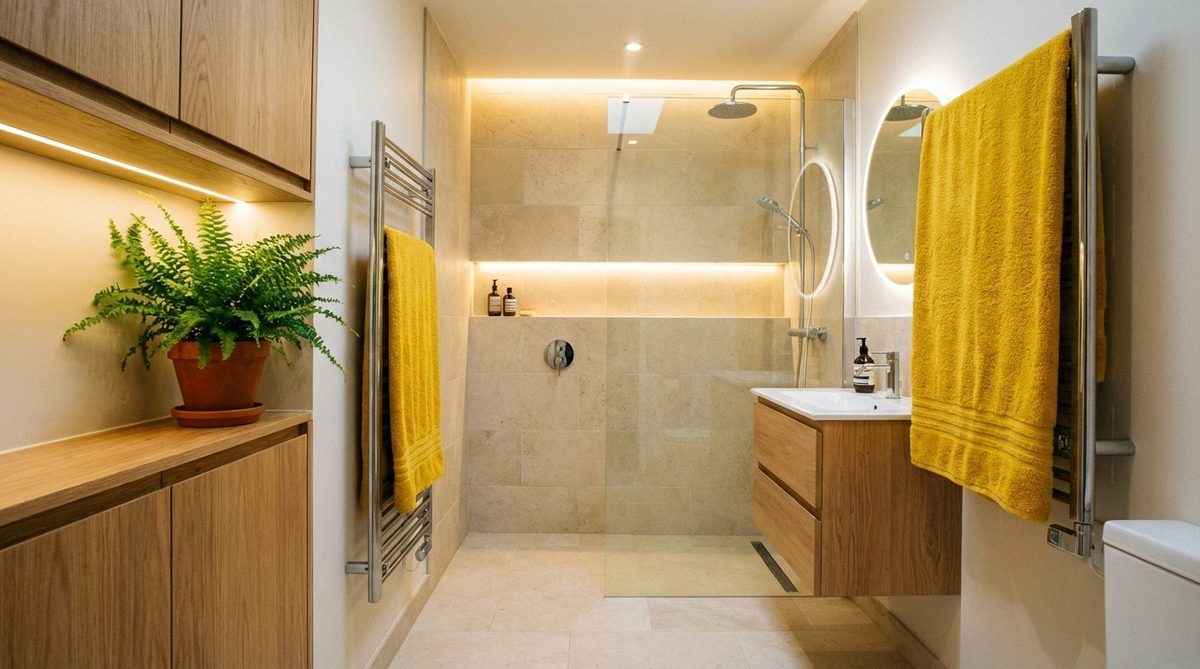
January 23. It is deep winter. You wake up in the dark. You walk into a windowless bathroom. It feels like a tomb. The gloom drains your spirit before the day has even started. We often think white walls are enough. Or maybe we just blast ceiling spots into the room. The result is usually cold. Clinical. Uninviting.
You do not need a major renovation to fix this. You need to understand how light hits surfaces. You need to create an illusion. In the depth of winter, we want our homes to feel like sanctuaries. We want to push back the gray. Here is a specific combination that changes everything. It tricks the eye. It expands the space.
Зміст
Escaping the “sardine can” effect with perspective
The main enemy of a small, dark bathroom is the feeling of oppression. The walls seem to lean in. The air feels thin. This is the “sardine can” syndrome. In slow living, we want spaces that help us breathe, not restrict us. The goal is not just to see. The goal is to feel open.
To counter this, you need a double illusion. You must push back the physical walls. You must also simulate a natural light source where none exists. Most people fail here. They put a small mirror over the sink. They add a central ceiling light. The shadows get harsh. The room feels narrower.
Think of your bathroom as a stage. You are the director. If you cannot drill a hole for a window, you build one from scratch. This is the perfect time to hunt for the two key elements that create this “fake window” effect.
The star duo: oversized mirror and daylight LED
This is the secret. You need one large mirror. You need one specific type of light.
Stop buying standard sizes. In a small room, you must think big. Install an XXL mirror. Make it as wide as possible above the vanity. If your budget allows, cover an entire wall. Visually, a large mirror doubles the depth of the room. It breaks the boundary of the wall. It reflects the space back at you. Your brain registers continuity. It feels like the room goes on.
But a mirror in the dark just reflects blackness. This is where the lighting matters. You cannot use any bulb. You need a specific color temperature.
Choose bulbs or LEDs that are neutral white, between 4000 and 5000 Kelvins. This range mimics the sun at midday. It is natural. It is clear.
If you go too yellow (below 3000K), the room looks tired. Dated. Claustrophobic. Especially in winter. If you go too blue (above 6000K), you get a washed-out look. It feels like a hospital. Sterile. Cold.
The combo of a giant mirror plus 4000K daylight creates a virtual window. The mirror captures that crisp white light and scatters it. Colors pop. The space breathes. You get that immediate sense of cleanliness and openness. You wake up in light, not gloom.
Try it. See how the shadows move. The room changes character completely.
You bought the right bulbs. You installed the vanity. But the room still feels flat.
It happens to the best of us. You think you nailed the aesthetic. Then you step in front of the mirror at 7 AM. The shadows under your eyes look like bruises. The lighting from overhead creates a harsh, unflattering glare. It’s not just bad ambiance. It’s bad optics.
To fix this, you have to stop treating light as an afterthought. It needs to be part of the architecture.
Positioning beats brightness
Overhead lighting is the enemy of a flattering vanity. It casts shadows downward. That’s why you look tired. Even if you have expensive fixtures, if they only come from the ceiling, you are fighting physics.
Place your light source around the mirror. Ideally, use sconces on each side of the face. This creates frontal illumination. It flattens shadows. It evens out the skin tone.
If you can’t rewire, consider a backlit mirror. Or install a high-output LED strip along the top perimeter. It’s modern. It’s clean. And it pushes light evenly across the entire surface.
The CRI metric you can’t ignore
Color temperature is half the battle. The other half is accuracy.
Look at the CRI, or Color Rendering Index. You need high numbers here. Aim for above 90.
Why does this matter? A low CRI bulb distorts colors. Your skin looks sallow. Your makeup application will be off. High CRI bulbs render colors as they truly are. It’s the difference between a flattering portrait and a distorted reflection.
Combine this with “daylight” bulbs, typically around 5000K. This mimics natural sunlight. It cuts through the gloom of winter mornings.
“It’s a minimal investment for a radical improvement in daily comfort.”
Three small details that amplify the effect
You don’t need a full remodel to boost the impact. These three tweaks cost almost nothing but change the entire feel of the space.
- Switch your wall paint. Matte finishes absorb light. They kill brightness. Switch to satin or velvet sheen. These finishes reflect light back into the room without being overly glossy. It adds depth.
- Clear the sightlines. A shower curtain breaks the visual flow. It traps light. Replace it with a transparent glass partition. Light circulates freely. The space feels larger. The vanity feels more integrated.
- Add greenery. Not just for looks. A plant like a Zamioculcas or a Pothos adds organic texture. These plants thrive in lower light conditions. When hit by that daylight-balanced bulb, the green pops. It brings in that “spa” vibe. It counters the sterile feel of hard surfaces.
The psychological weight of light
Light influences mood more than we admit.
A dark, poorly lit bathroom feels like a chore. A well-lit one feels like a sanctuary. By manipulating reflection and color temperature, you turn an architectural constraint into an asset.
Test the effect. Swap out your current bulbs for high-CRI daylight options. See how the space transforms. It’s not just about seeing yourself clearly. It’s about feeling good in the space.
What’s your trick for bringing more sun into the house during the long winter months?