




























Most homeowners assume nailing wood together is straightforward. It isn’t.
You are dealing with a massive variety of shapes, sizes, and metals. If you’ve ever stared down a hardware store aisle wondering how many types of nails exist, you’re not alone. There are dozens. They keep our decks standing and our cabinets attached. But picking the wrong one can lead to split wood, rust stains, or a job that falls apart in a year.
Let’s cut through the noise. We are focusing on the hardware, not beauty salon treatments. If you need advice on manicures, close this tab. If you need to build something, stay.
Зміст
How to Choose Nail Size and Quantity
Steel is the default. It’s cheap and strong. But if you are working outside, in a bathroom, or near the ocean, steel will rust. You need aluminum, brass, copper, or stainless steel for those spots.
Coatings matter too.
– Galvanized: Zinc-coated. Best for outdoor use.
– Blued: Heat-treated. Good for interior framing.
– Cemented: Coated with adhesive. Helps them bite into concrete or hard masonry.
Understanding the Penny (d) System
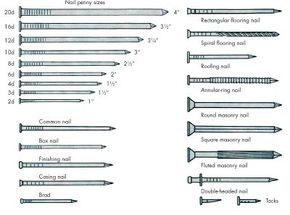
Nail size isn’t measured just by inches. It’s measured in “pennies,” denoted by the letter d. This old metric refers to the price per hundred nails from centuries ago. Today, it just tells you length.
- 2d: 1 inch long.
- 60d: 6 inches long.
Anything under 1 inch is a brad. Anything over 6 inches is a spike.
Here is the golden rule of nail length: At least two-thirds of the nail must penetrate the base material.
Imagine you are attaching a 1×3 board to a 4×4 beam. The board is 0.75 inches thick. You need an 8d nail, which is 2.5 inches long.
– 0.75 inches goes through the thin board.
– 1.75 inches drives into the beam.
That 1.75 inches is well over two-thirds of the beam’s width (3.5 inches). It holds. If you used a 6d nail (2 inches long), you’d only get 1.25 inches into the beam. Weak. It pulls out.
Buying by the Pound
Nails are heavy. They sell by weight.
– Small nails: Thousands per pound.
– Large spikes: Dozens per pound.
You can buy bulk nails from a keg. You weigh the box, then pay the retailer. It’s messy but cheap.
Most DIYers don’t need a keg. Buy 1-pound to 5-pound boxes. Keep a few common sizes in your garage. You will outlast the box for most repairs.
The Most Common Types of Nails
Not all nails are created equal. The head shape, shank thickness, and coating dictate the job.
Common Nails
These are the workhorses. Thick shank. Wide, flat head. Designed for rough framing and heavy construction.
They are cut from wire, not drawn, making them stronger but rougher. Sizes range from 2d to 60d. If you are building a deck frame or a shed, you are likely using common nails. They provide massive holding power in wooden structures.
Box Nails
Lighter than common nails. Smaller diameter.
Why do they exist? To stop splitting.
When you are nailing thin plywood or constructing a crate, a heavy common nail will blow the wood apart. Box nails have a lighter gauge. They slip in with less force. They don’t have the same sheer strength as common nails, but for light construction and boxes, they are perfect.
Finishing Nails
Fine woodworking doesn’t like big heads. They ruin the look.
Finishing nails have a small head and a thinner shank. They are used for trim, paneling, and baseboards. The thin shank reduces splitting, and the small head sits almost flush with the surface. You can fill the tiny hole with wood putty later.
Roofing Nails
Asphalt shingles tear easily. A standard nail head might rip through the material.
Roofing nails have a much larger, broader head. This distributes pressure. They are also usually galvanized for weather resistance. The shank is often shorter than a common nail of the same “penny” size.
If you are securing shingles, do not use common nails. You need roofing nails. They ensure durability against wind and rain.
Drywall Nails
Drywall needs to stay put. Ringed nails (annular rings) have sharp ridges along the shaft. This creates friction.
They also have an indented head to keep them from sinking too deep into the gypsum. This is specific to drywall installation. Don’t use them for framing.
Masonry Nails
Concrete and brick are hard. Standard nails bounce off.
Masonry nails are made for attaching wood to masonry. There are three types:
1. Round
2. Square
3. Fluted
They are hard steel. They require a hammer blow or a masonry nailer.
Warning: Do not use these for high-strength applications. If you need to fasten heavy loads to brick or reinforced concrete, use screws or lag bolts. Masonry nails are for light fixtures, trim, or attaching blocking.
Less Common Types of Nails
Sometimes the standard hardware store shelf doesn’t have what you need. These specialized nails solve specific problems.
Brad Nails
Smaller than finishing nails. Virtually headless.
They are used for delicate trim work. Crown molding, shoe molding, baseboards. The goal is invisibility. You don’t want to see the nail. You don’t want to split the expensive hardwood trim.
Brad nails fit into nailers that shoot them in at high speed. For hand hammering, they are tiny. They are essential in fine carpentry where aesthetics matter more than brute force.
Duplex Nails
Double-headed.
You have never seen these unless you are on a construction site. They are used for temporary structures. Scaffolding. Concrete formwork.
Why? Easy removal.
You hammer the first head in. When the temporary job is done, you lever the second head to pull the nail out instantly. No drilling. No damage to the wood underneath. They are a staple for temporary construction sites.
Spiral Shank Nails
Friction is the enemy of withdrawal.
These nails have a spiraled or ringed shank. They twist into the wood. This creates massive friction. They resist pulling out better than smooth-shank nails.
Ideal for flooring and decking. When that deck board expands and contracts with the weather, a smooth nail might wiggle loose. A spiral nail holds fast. Use them in high-stress applications where movement is expected.
Wood Nails
Metal isn’t always the answer.
Wood nails are made entirely of wood. They look like dowels with a tapered head. They are used where metal would corrode or react with the wood fibers over time.
They are less strong than metal nails. You wouldn’t use them for framing. But for aesthetic repairs or specialized joinery where metal shows or rusts, they are useful. They don’t split wood as easily as metal because they compress the fibers rather than cutting through them.
You now know the difference between a box nail and a common nail. You know why penny size matters.
The next time you pick up a hammer, look at the shank. Look at the head. Ask yourself what the wood is going to do in five years.
If you are building something permanent, use the right steel. If it’s temporary, use the double-headed ones. The rest is just practice.
There is always another nail. And another project.
Tacks and Corrugated Fasteners: The Small Stuff That Holds It Together
Tacks and corrugated fasteners look like nails but act differently. If you treat them the same, you’ll ruin your project.
Tacks come in round or cut shapes. They hold carpet or fabric to wood. Upholstery tacks have decorative heads. They are for looks as much as function.
Corrugated fasteners have a different name. People call them wiggly nails. You use them for light-duty joints. Strength does not matter here. You set them at right angles to the joint. It’s a quick fix for weak connections.
Knowing Your Types of Nails Matters
The nail world is complex. Each type has a specific job. Common nails are not the same as masonry nails. Pick the wrong one and your structure fails.
Pay attention to the details. Extra length matters. Thinner materials matter. Cupped heads matter. A hardware store clerk can spot your mistake if you ask for the wrong thing.
Not what you’re looking for? Try these:
-
Home Repair Tools: Whether you prefer to use the Yellow Pages for anything that needs fixing around the house or consider yourself a regular do-it-yourselfer, there are a handful of tools that everyone should have in their tool box. Learn all about them in this article.
-
Fasteners: Fasteners, such as nails and screws, are used to connect two things together. Learn about the types of fasteners available and what they are typically used for on this page.
-
Hammer: A hammer just might be the most common home repair tool around, used by even the least handy of people for simple projects like hanging a picture on the wall. Find out more about the types of hammers available on this page.