























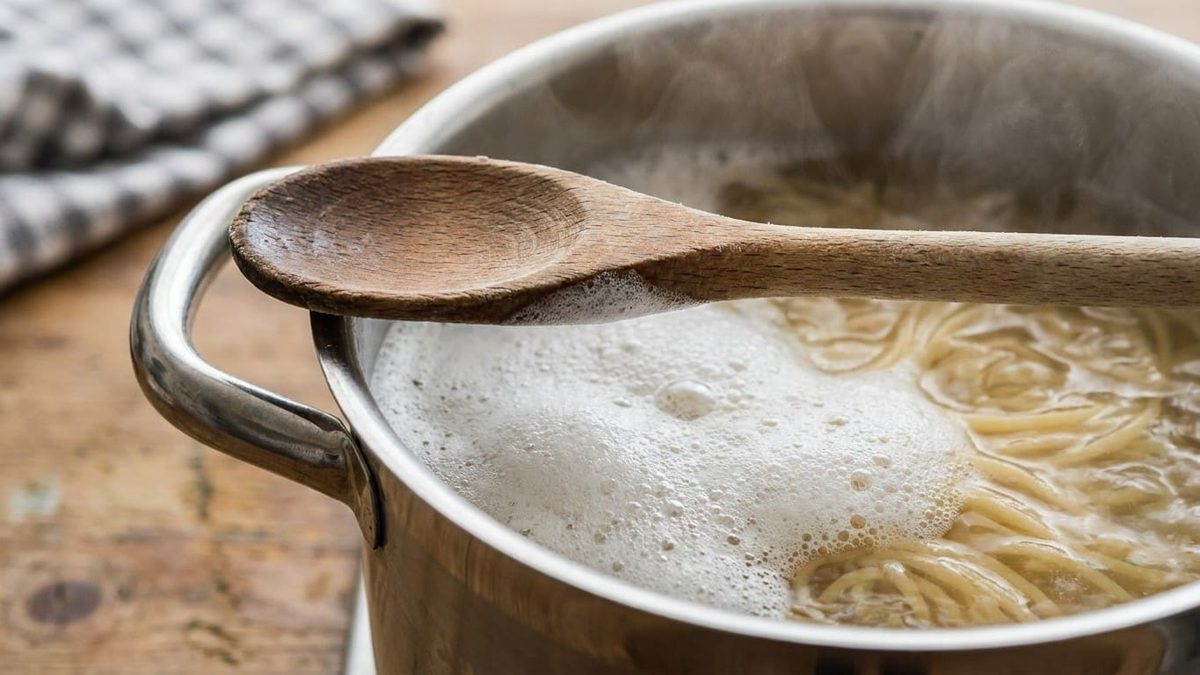
Three years. That’s how long I stood guard over my pasta pots, treating it like a volatile chemical experiment. Hand hovering over the gas knob, waiting for that first suspicious tremor. Then one night, exhausted by the vigilance, I just tossed a wooden spoon across the rim. The water boiled hard for twenty minutes. Not a single drop escaped.
I stopped watching the pot like it was about to detonate. Since then, I’ve never looked back.
The surprise wasn’t that it works. It’s realizing this old-wife’s-tale hack actually rests on solid physics. It’s not magic. It’s mechanics.
Зміст
The Real Culprit: Starch and Surface Tension
Let’s clear up a myth right now. The overflow isn’t happening because the water is “too hot” or the flame is “too strong.” That’s what I believed for years.
The problem starts when you add starchy foods—pasta, rice, potatoes. These contain long chains of sugar molecules. When they hit boiling water, those molecules release. They act like natural surfactants. They change the surface tension of the water. This creates an elastic film over the steam bubbles.
The bubbles don’t just pop and vanish anymore. They become resistant. They stack up. They form a thick, stable foam.
This foam acts like a soft lid. Steam gets trapped underneath. Pressure builds. The white mass rises like a miniature volcano until it crests the pot. Then comes the horror: it spills onto the stovetop. It evaporates. It leaves behind a layer of carbonized starch.
I’ve ruined two scrubbing sponges trying to get that off a glass-ceramic cooktop. No magic product fixes it. Just brute force and patience.
How the Spoon Breaks the Cycle
So, why does the spoon work? It’s a two-part mechanism.
First, there’s the physical barrier. You place the spoon horizontally across the pot’s rim. It’s a tiny wall. When the foam rises and hits the wood, the fragile bubbles are forced to burst. The structure of the foam breaks at its base. It’s a dam holding back a wave.
Second, there’s the material. Wood is a poor conductor of heat.
While the foam is hot, the wood stays relatively cool. When those hot bubbles hit the cooler wood surface, the temperature difference destabilizes them. The foam can’t maintain its structure. It collapses back into the pot.
One mechanism is mechanical. The other is thermal. Together, they stop the overflow. Neither would be nearly as effective alone.
The wooden spoon acts as both a physical barrier and a thermal shock device, breaking the elastic structure of starch-based foams.
You don’t need a spoon specifically made of oak. Any object placed across the surface will pierce the thick layer of bubbles formed by boiling. But wood is the traditional choice for a reason. It handles the heat shock better than metal, which might conduct the heat away too quickly or get too hot to touch.
Where the Hack Fails
This isn’t a talisman. I learned that the hard way.
I once filled my pot too full. I made the classic mistake of using a pot that was barely big enough for the water and pasta. There was no headspace. The foam needed room to expand. In a tight pot, it had nowhere to go but up and over.
Size matters. If you’re boiling a large batch, use a bigger pot. Give the foam space to breathe.
Time also plays a role. The wood doesn’t stay cold forever. After a few minutes, the spoon heats up. It soaks up water. The cooling effect diminishes. If you keep the flame high, the foam will eventually push past the spoon.
This is especially true with milk or fatty liquids. The spoon buys you time. It doesn’t replace proper heat management.
The Real Solution: Low and Slow
The most effective strategy combines the spoon with a simple adjustment to your stove.
Once the water reaches a boil, turn the heat down. Drop it to a simmer.
Violent, rolling boils are the main cause of overflow. A gentle simmer cooks the food just as well. It reduces the risk of the foam rising too fast. The spoon handles the minor bubbles. The lower heat prevents the major surge.
And here’s a detail I missed for a long time: this works with milk, too.
Milk is sneakier than pasta water. It contains proteins that stabilize foam. It overflows faster. If you’re heating milk for a sauce or cereal, put the spoon across the pot immediately. Do it before the smell of burnt dairy fills the kitchen.
It’s a small tool. A simple piece of wood. But understanding why it works changes how you cook. You stop fighting the boil. You start managing it.
The next time your pot threatens to boil over, don’t just panic. Place the spoon. Lower the heat. Watch it work.
Sources : tiktok.com | elleadore.com