Most modern houses don’t have them anymore. You won’t find hot water or steam radiators in new builds. But if you own an older home, these systems are likely still working hard to keep you warm. They require specific care to run efficiently. Ignoring them leads to cold spots, strange noises, and higher bills.
Water holds heat better than air. That’s why it’s the medium for these systems. There are two main types of hot water setups. The first is the gravity system. The second is hydronic, or forced hot water. Both can run on gas, oil, or electricity. Understanding which one you have matters for maintenance.
Зміст
Gravity vs. Hydronic Systems
Gravity systems rely on physics. Hot water rises. It moves from the boiler through pipes to radiators. The heat transfers to the metal of the radiator. Then to the air in the room. As the water cools, it sinks. It flows back to the boiler through return pipes.
These systems usually keep water between 180°F and 120°F. Not very hot by cooking standards, but enough for comfort.
Open gravity systems have an overflow outlet. This lets excess water escape. It prevents pressure buildup. Closed systems use a sealed expansion tank instead. When water expands, it goes into the tank. This protects the boiler and pipes.
Hydronic systems are similar to closed gravity systems. But they add a motor-driven pump. This pump forces water to move faster. The water arrives at the radiator with less heat loss. It’s more efficient. And it’s the standard for most mid-century homes today.
Proper maintenance of hot water and steam heating systems prevents pressure issues and ensures consistent heat distribution.
Slope, Water Level, and Expansion Tanks
Several factors determine if your system works. Get one wrong, and the heating fails. Or gets noisy.
Slope
Gravity systems need slope. All pipes and radiators must tilt back toward the boiler. If water can’t flow back, it stops circulating. You’ll hear hammering noises. Rooms won’t heat up.
Check the slope. Prop up radiators if needed. Fasten pipes so they tilt correctly. A few degrees makes a difference.
Water Level
The boiler needs water. About half full is the sweet spot. You need an air space between the water surface and the top of the tank. Too low, and the heater struggles. It won’t distribute heat properly.
Most systems have an automatic fill valve. It keeps the level steady. But if the water level drops consistently, look for leaks. Close the supply valve. Watch the level for two or three days. If it drops drastically, call a pro. Don’t try to fix major leaks yourself.
Expansion Tank
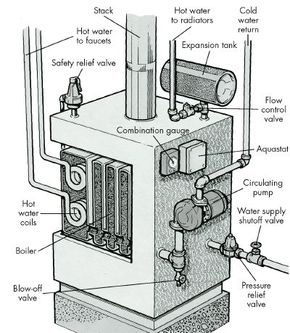
Water expands when heated. It wants to turn into steam if unchecked. The expansion tank and pressure-reducing valve keep it liquid. Usually, the tank hangs from the basement ceiling near the boiler. Older homes might have it in the attic.
The tank needs air inside. Air compresses. Water doesn’t. If the tank fills with water, it can’t absorb the expansion. Pressure builds. It forces water out of the safety relief valve above the boiler. That’s a waste of heat and water.
How do you know if the tank is full of water? Touch it. The bottom half should feel warmer than the top. If the whole tank is hot, it’s filled with water. Drain it.
How to Drain an Expansion Tank
- Turn off power to the boiler.
- Close the water supply shutoff valve.
- Let the tank cool.
- If you have a combination drain valve, attach a garden hose. Drain 2 or 3 gallons.
- If there’s no combination valve, shut the valve between the tank and boiler. Drain the tank completely.
- Turn the water supply back on.
- Restore power to the boiler.
You don’t need to refill the tank. The system fills it naturally as it operates.
Essential Tools
You don’t need a professional toolkit for basic checks. Just these items:
- Wrench
- Garden hose
Regular servicing keeps the system running. Radiators need attention too. We’ll cover that next.
Fixing Cold Zones and Pump Noise
You’ve got heat, but not where you need it. That’s a classic symptom of air locks or improper balancing. Start with the radiators themselves. If a unit is ice-cold but the piping leading to it looks level and intact, check the inlet valve. It needs to be fully open. Period. If it’s only cracked open, you’re choking the flow.
Uneven heating? That’s usually an air distribution issue. The vents matter here. You want the ones farthest from the boiler to open wider than the ones closest to it. This helps balance the pressure so steam or hot water doesn’t just stall out near the source.
To bleed the system, find the air vent valve on the radiator. Use the manufacturer’s key or a screwdriver to open it. You’ll hear a hiss. Wait for that hiss to stop and water to actually drip out. That’s your signal. Close it back up. If you want more heat, crack it open just a tiny bit. Some modern units have automatic valves that handle this for you, so check your model specs. If you don’t have the specific key, a heating supply store will have one. Don’t guess with generic tools; you can strip the valve.
Then there’s the circulator. It’s the pump forcing water through your loops. When it fails, it’s loud. Usually, the coupler separating the motor from the pump has broken. Or, you’re seeing water leaks from the pump body itself, which means the seal is shot. These are mechanical failures. If you hear grinding or see pooling water under the unit, stop tinkering. Call a pro. DIY on a broken circulator motor is a recipe for a flooded basement.
Stopping Leaks at the Inlet Valve
Hot water systems leak. Pipes loose. Valves worn. Pipe leaks often stem from loose fittings. Tighten them with a wrench. Simple. But leaks around the inlet valve? That’s wear and tear. Specifically, the stem packing or the washer inside.
Replacing the washer requires precision. You’ll need a screwdriver, replacement washers, and new packing material. Here is the sequence:
- Shut off the boiler. Let it cool. You don’t need to shut off the main water supply; as the system cools, water naturally recedes back toward the boiler.
- Disassemble the handle. Remove the screw holding the handle in place. Unscrew the packing nut. Pull off the handle. Back out the valve stem or body.
- Swap the washer. Locate the screw and washer at the bottom of the stem. Replace it with a new one. Must be the same size and type. Wrong size means a leak.
- Repack. Install new packing material while you reassemble the valve.
- Reassemble and test. Tighten everything back down. Turn the system back on.
You need a wrench and a garden hose for the next steps, too.
Annual Flushing and Emergency Draining
Once a year, flush the system. Keep the pipes clear. Open the blow-off valve. Let the water run into a bucket. Watch the color. When it runs clear, stop. If it stays rusty after flushing, call a professional. You might have sludge buildup that requires a more aggressive chemical treatment or professional flushing service.
Draining is different. You do this to prevent freezing during a power outage or to make major repairs.
Here’s how to drain safely:
- Turn off the power to the boiler. Wait for the water to cool until it’s just warm. Hot water drains are dangerous.
- Shut off the water supply valve. Attach a garden hose to the boiler drain port.
- Open the drain valve and open the air vents on all radiators. This lets air in so water can flow out. Give it time. Gravity is slow.
- Refilling. Close the air vents on the radiators first. Shut the drain valve. Turn the water supply back on to the boiler.
- If your boiler has an automatic shutoff, it will stop when full.
- If it doesn’t, fill it until the combination gauge reads 20 psi.
- Purge and Set Pressure. Release air from all convectors. They need to heat properly. The gauge should read 12 psi.
- If it’s below 12 psi, add water.
- If it’s above 12 psi, drain a little off.
Maintaining 12 psi is standard for residential systems. Deviate too far, and you risk pressure relief valve activation or airlocks returning.
System Basics and Safety
Boilers aren’t just for homes. They power turbines, sterilize hospital equipment, and heat commercial spaces. But for your house, the goal is efficiency. The standard hot water boiler temperature is 140 degrees F (60 degrees C). You can drop it to 120 degrees F (49 degrees C) if you’re worried about energy bills. It saves money. It just takes a bit longer to heat the rooms.
Don’t confuse a boiler with a hot water heater. A heater just makes water for sinks and showers. A boiler heats water and uses that heat to warm your home’s air or radiators. They are distinct systems.
If your system starts acting up, check for the usual suspects. Loose valves. Air in the lines. Failed seals. If those don’t fix it, you’re likely looking at a control board failure or a cracked heat exchanger. Those aren’t DIY fixes.
You’ve got the basics. The tools are simple. The steps are linear. But systems age. Metal fatigues. Seals harden. Keep an eye on the pressure gauge. Listen for the circulator. Watch the water color when you flush. Small issues become big problems if you ignore the signals.


