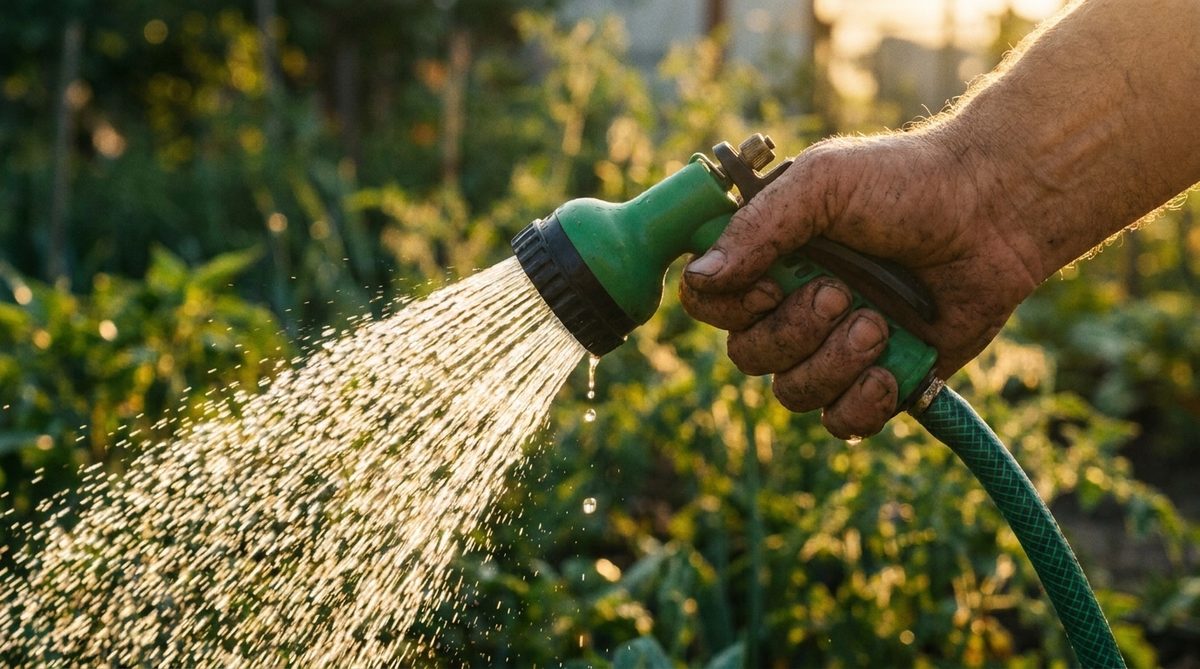
Spring turns into summer and the heat is intense. You will see your tomato leaves drooping. Grab the hose. It feels urgent. It feels like liberation.
It’s a trap.
Watering your garden with hot water from a hose or metal jug during a heat wave is one of the most fatal mistakes a homeowner can make. Think you’re saving your plants. You are actually scalding them. The damage is done underground. You won’t see it on the leaves right away. If you do, it may be too late.
This is not about over watering. It’s about heat shock. And the solution is easier than you think.
Зміст
How hot water from a hose damages plant roots
Imagine a black plastic pipe lying on hot asphalt. Or a metal watering can on a south-facing balcony. The sun doesn’t just heat the air. It cooks the water inside the container.
Plastic and metal are heat conductors. After just a few hours of direct sunlight, the water inside can reach a literal boiling temperature. Not lukewarm. Boiling hot.
When you pour this boiling hot liquid on dry soil, you get a thermal shock. The roots of the plants are already stressed. They work overtime to remove moisture from the volatile soil as the air temperature rises. They are fragile.
Pouring hot water on them is like pouring boiling water on an open wound. It destroys the root tissue. It boils the cells. The plant does not die immediately. It withers. It fades. It collapses days later when the roots can no longer support the leaves.
Therefore, summer gardening requires more than just water. It requires temperature control.
A two-second test to save plants
In the south of France, there is a trick used by experienced vegetable gardeners. It takes two seconds.
Touch the water before watering.
Yes, really. Put your hand under the current. Feel the temperature.
If the water feels warm on your skin, it is too hot for your plants. Your skin is tougher than the root tissue. If it’s hot for you, it’s deadly for them.
Here is the solution. Let the water flow for a few seconds before it hits the ground. This washes away the water that has been sitting in the sun and warming up in the pipe or can. If it still feels hot, wait. Wait for the sun to move. Wait for the tube to cool.
It may seem pointless to pour a liter of water on a gravel path. Do it anyway. A wasted liter is better than a dead tomato plant that took months to grow.
It is better to lose a little water than to lose a crop.
Why morning watering and shade are important
Your gear is important. A metal watering can is essentially a radiator. It retains heat throughout the day. Keep it in the shade. If possible, use thick-walled plastic or ceramic containers. They are more resistant to temperature spikes.
Timing is everything. The golden rule of summer watering is simple: early in the morning.
Water at dawn. The air is cool. The soil is cool. Plants absorb water slowly. They hydrate before the sun turns the day into an oven. This gives them strength to withstand the heat.
Watering in the middle of the day is risky. There is a danger that the leaves will be burned by the droplets, which act as magnifying glasses. There is a risk of shocking the roots with hot water. There is a danger that half of your effort will be wasted in evaporation.
Plants tolerate drought better than heat shock. A dry plant can withstand a dry period. A scalded plant is done.
Soil ecosystem protection
Watering is just one part of keeping your garden vibrant in the summer. You also need to protect the soil itself.
Mulch is your best friend. A layer of organic material on the surface – straw, wood chips, compost – keeps the soil cool. It reduces evaporation. It keeps the roots moist. It dampens temperature fluctuations.
If you haven’t mulched this year, start now. It’s not too late. Pull out the hose, check the water temperature and focus on keeping the soil alive.
Your garden is a delicate balance between heat, water and root health. If one variable is missing, the whole system suffers.
Have you mulched your garden beds this year? Or do you still rely on the hose as usual?